
Introduction
Writer's block is universal. Whether you're a novelist stuck on chapter seven, a screenwriter facing a blank page, or a content creator needing fresh narrative ideas, an AI story generator can be the creative catalyst you need. But not all AI writing tools are created equal. Some excel at long-form fiction, others at dialogue, and some at world-building. We tested 12 popular AI story generators, evaluating them on creativity, coherence, customization, and value.
Quick Answer: For serious fiction writers, NovelAI offers the best creative control. For ease of use and versatility, Sudowrite remains our top recommendation. Budget-conscious writers should check out ChatGPT Plus for the best value.
The 7 Best AI Story Generators for Creative Writers
NovelAI
Best for Fiction Writers
Best for: Novelists and fiction authors seeking creative control
Pricing: Free trial (50 generations) | Tablet: $10/month | Scroll: $15/month | Opus: $25/month
NovelAI is purpose-built for fiction writing, offering unmatched control over narrative style, character voices, and world-building. Unlike general-purpose AI tools, NovelAI understands story structure and maintains consistency across long-form content.
Key Features
- Custom AI models trained on fiction
- Memory system for character/plot consistency
- Lorebook for world-building details
- Multiple writing modules (Prose, Dialogue, Poetry)
- Style customization (mimic famous authors)
- Image generation for character/scene visualization
- End-to-end encryption (privacy-focused)
Pros
- Best-in-class for creative fiction
- Excellent long-term memory
- Strong community and custom scenarios
- No content filters (write what you want)
- Affordable entry price
Cons
- Steeper learning curve
- Interface less polished than competitors
- Image generation costs extra credits
Pro Tip:
Spend time setting up your Lorebook with character details, locations, and world rules before starting. This dramatically improves consistency across chapters.
Sudowrite
Best for: Authors wanting an AI writing partner
Pricing: Free trial (4,000 words) | Hobby: $19/month | Professional: $29/month | Max: $129/month
Sudowrite positions itself as an "AI writing partner" rather than a replacement—and it delivers. With features like "Describe" (sensory details), "Expand" (flesh out scenes), and "Twist" (plot ideas), it augments rather than replaces your creativity.
Key Features
- Canvas for visual story planning
- Brainstorming tools (characters, plot points, world elements)
- Rewrite options (tone, style, intensity adjustments)
- Feedback mode (analyzes your draft like a beta reader)
- Chrome extension for Google Docs
- Collaborative features
Pros
- Exceptional for brainstorming and ideation
- Beautiful, intuitive interface
- Great educational resources
- Strong community of authors
- Regular feature updates
Cons
- Expensive compared to alternatives
- Better for augmentation than generation from scratch
- Can be overwhelming with features
Best Use Case: Use Sudowrite when you're stuck on a scene, need sensory descriptions, or want feedback on your draft. It's less effective for generating entire stories from prompts.
Jasper (formerly Jarvis)
Best for: Content creators and marketers who also write fiction
Pricing: Creator: $49/month | Teams: $125/month
Jasper is primarily a marketing AI tool, but its "Creative Story" template and long-form editor make it viable for fiction—especially if you also create marketing content.
Key Features
- 50+ writing templates
- Boss Mode long-form editor
- Brand voice customization
- SEO integration (Surfer SEO)
- Plagiarism checker (Copyscape)
- Team collaboration
- Chrome extension
Pros
- Versatile (marketing + creative)
- Professional output quality
- Strong templates and frameworks
- Good for writers who wear multiple hats
Cons
- Expensive for pure fiction use
- Less creative than NovelAI or Sudowrite
- Marketing focus evident in output
Rytr
Best for: Budget-conscious writers
Pricing: Free: 10,000 characters/month | Saver: $9/month | Unlimited: $29/month
Rytr offers an impressive ai story generator experience at a fraction of the cost. While less sophisticated than premium options, it's perfect for writers testing AI assistance or working with tight budgets.
Key Features
- 40+ use cases including Story Plot and Creative Writing
- 30+ languages
- 20+ tones of voice
- Chrome extension
- Plagiarism checker
- Team collaboration (paid plans)
Pros
- Very affordable
- Generous free tier
- Simple, clean interface
- Good for short stories and outlines
Cons
- Less creative than premium tools
- Struggles with long-form consistency
- Output can feel generic
ChatGPT Plus (GPT-4)
Best for: Versatile writing with custom instructions
Pricing: $20/month
While not purpose-built for fiction, GPT-4's versatility makes it a surprisingly capable ai story generator—especially with custom instructions and the right prompting techniques.
Key Features
- State-of-the-art language model
- Custom instructions for consistent voice
- Memory across conversations
- Web browsing (for research)
- Code interpreter (for complex plotting)
- DALL-E 3 integration (illustrations)
- GPTs (custom AI assistants)
Pros
- Best value for versatility
- Excellent at following complex instructions
- Can switch between tasks (research, writing, editing)
- Constant improvements from OpenAI
- Massive community for prompt sharing
Cons
- Not purpose-built for fiction
- Requires prompt engineering skills
- Content filters may limit certain genres
- No built-in story organization tools
Pro Tip:
Create a custom GPT specifically for your story with detailed instructions about style, tone, and world-building. This dramatically improves consistency.
Writesonic
Best for: AI article and story generation
Pricing: Free: 10,000 words/month | Small Team: $19/month
Writesonic's "AI Article Writer" and story templates offer a middle ground between marketing tools and creative writing assistants.
Key Features
- AI Article Writer 5.0
- Story generator templates
- Chatsonic (ChatGPT alternative)
- Photosonic (AI images)
- Browser extension
- 25+ languages
Pros
- Good free tier
- Fast generation
- Decent for short stories
- Marketing features if needed
Cons
- Less creative than dedicated fiction tools
- Quality varies by template
- Better for articles than novels
ShortlyAI
Best for: Minimalist writers who want AI assistance
Pricing: $79/month (annual: $65/month)
ShortlyAI takes a minimalist approach—just you, a blank page, and AI that continues your story when you hit writer's block. No templates, no clutter.
Key Features
- Clean, distraction-free interface
- Slash commands (/instruct, /rewrite, /expand)
- Adjust output length and creativity
- Works like an infinite writing partner
Pros
- Beautiful minimalist design
- No distractions
- Good for getting into flow state
- Unlimited generations
Cons
- Expensive for features offered
- No organizational tools
- Limited customization
- Better alternatives at lower price
Comparison Table
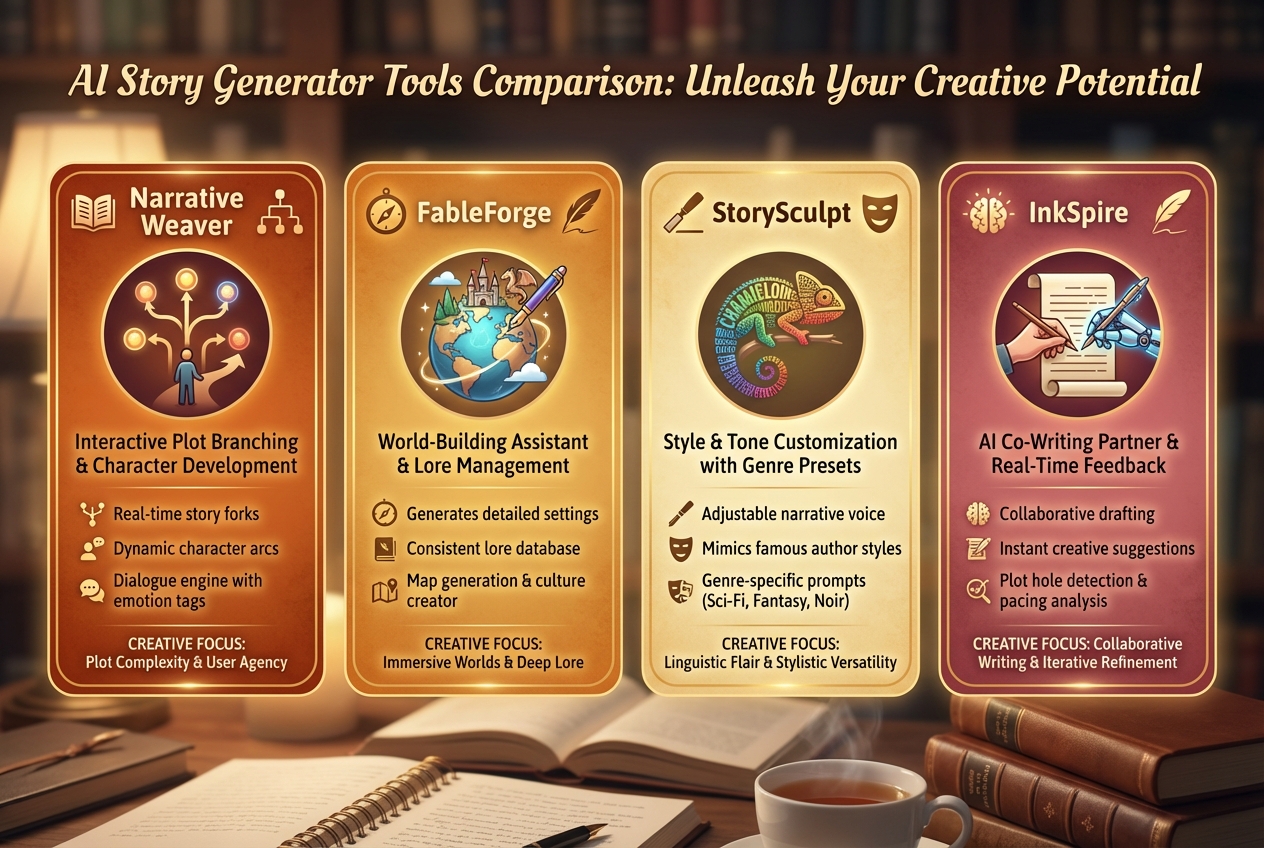
| Tool | Best For | Price | Free Tier | Creativity |
|---|---|---|---|---|
| NovelAI | Fiction authors | $10-25/mo | 50 generations | Long-form |
| Sudowrite | Writing partner | $19-129/mo | 4K words | High |
| Jasper | Multi-purpose writing | $49+/mo | None | Moderate |
| Rytr | Budget option | $9-29/mo | 10K chars | Moderate |
| ChatGPT Plus | Versatility | $20/mo | Limited | High |
| Writesonic | Short stories | $19+/mo | 10K words | Moderate |
| ShortlyAI | Minimalists | $65-79/mo | None | Moderate |
How to Choose the Right AI Story Generator
Consider Your Writing Goals
Novel/Book Writing: NovelAI (best consistency) or Sudowrite (best assistance)
Short Stories: Rytr (budget) or ChatGPT Plus (versatility)
Screenplays: Sudowrite (formatting support) or ChatGPT Plus (custom instructions)
Content + Fiction: Jasper (marketing features) or ChatGPT Plus (all-purpose)
Evaluate Your Budget
- Under $15/month: Rytr, NovelAI (Tablet plan)
- $15-25/month: NovelAI (Scroll), ChatGPT Plus
- $25-50/month: Sudowrite (Hobby), Jasper
- Premium ($50+/month): Sudowrite (Professional), ShortlyAI
Test Before Committing
All recommended tools offer free trials or tiers. Test with:
- A complex character description
- A dialogue-heavy scene
- A plot outline request
- Continuation of your existing writing
Tips for Getting the Best Results from AI Story Generators
- Master Prompt Engineering
Weak prompt: "Write a fantasy story"
Strong prompt: "Write an opening scene for a dark fantasy novel featuring a disgraced knight who discovers a conspiracy in the royal court. Tone: gritty, morally ambiguous. Style: George R.R. Martin meets Joe Abercrombie. 800 words."
Iterate and Refine
AI rarely nails it on the first try. Use the output as a starting point:
- Take what works
- Rewrite what doesn't
- Ask the AI to expand on specific sections
- Combine multiple generations
Maintain Your Voice
AI can mimic styles, but your unique voice matters. Use AI for:
- Overcoming writer's block
- Generating ideas
- Expanding descriptions
- Checking pacing
Not for:
- Final prose (without editing)
- Replacing your creative decisions
- Publishing raw output
Organize Your Project
AI tools lack novel-length organization. Use:
- NovelAI's Lorebook for world-building
- Sudowrite's Canvas for visual planning
- Notion or Scrivener for manuscript organization
- Custom GPTs in ChatGPT for story-specific knowledge
The Ethics of AI-Assisted Writing
Disclosure
Consider transparency:
- Competitions: Most prohibit AI assistance—check rules
- Publishing: Traditional publishers have varying policies
- Readers: Some genres expect disclosure (academic, journalism)
Finding Your Balance
AI is a tool, not a replacement. The best approach:
- Use AI for ideation and first drafts
- Heavy editing and revision by you
- Final polish reflects your voice and vision
- AI handles the mechanical; you provide the soul
Frequently Asked Questions
Can AI story generators write entire novels?
Technically yes, but practically no. Current AI can generate coherent chapters but struggles with:
- Long-term plot consistency
- Character development arcs
- Thematic depth
- Original voice
Best practice: Use AI for sections, outlines, or overcoming blocks—not complete manuscripts.
Will publishers accept AI-assisted writing?
Policies vary:
- Traditional publishers: Generally expect human-written work
- Self-publishing: No restrictions, but disclosure may affect reader trust
- Literary magazines: Most prohibit AI-generated submissions
Always check specific guidelines and consider disclosure.
Are AI story generators plagiarism-free?
Reputable tools generate original text. However:
- Output may resemble training data stylistically
- Some tools include plagiarism checkers
- Always verify originality for published work
- AI can't infringe copyright, but mimicry is possible
What's the best free AI story generator?
Rytr offers the most generous free tier (10,000 characters/month) with dedicated story features. ChatGPT (free) works for testing but has usage limits and less creative capability than GPT-4. NovelAI offers 50 free generations to test the platform.
Can AI match human creativity?
Not yet. AI excels at:
- Pattern recognition and replication
- Generating variations on themes
- Following explicit instructions
Humans still lead in:
- Original conceptual thinking
- Emotional authenticity
- Cultural nuance
- Intentional subversion of tropes
The best results come from human-AI collaboration.
How do I maintain my writing voice when using AI?
- Provide examples: Share samples of your writing for the AI to match
- Use custom instructions: Set tone, style, and vocabulary preferences
- Edit heavily: Treat AI output as a rough draft
- Limit AI to specific tasks: Outlines, descriptions, dialogue—keep key scenes human-written
Conclusion
The best ai story generator depends on your specific needs:
- Serious fiction writers: NovelAI offers unmatched creative control
- Authors wanting a partner: Sudowrite augments your creativity beautifully
- Budget-conscious: Rytr or ChatGPT Plus deliver solid value
- Versatility seekers: ChatGPT Plus handles fiction plus everything else
AI won't replace human creativity, but it can be a powerful ally in overcoming blocks, generating ideas, and accelerating your writing process. The key is finding the right tool for your workflow and using it ethically and effectively.
Our top pick: Start with NovelAI if fiction is your primary focus, or ChatGPT Plus if you want versatility across writing tasks.