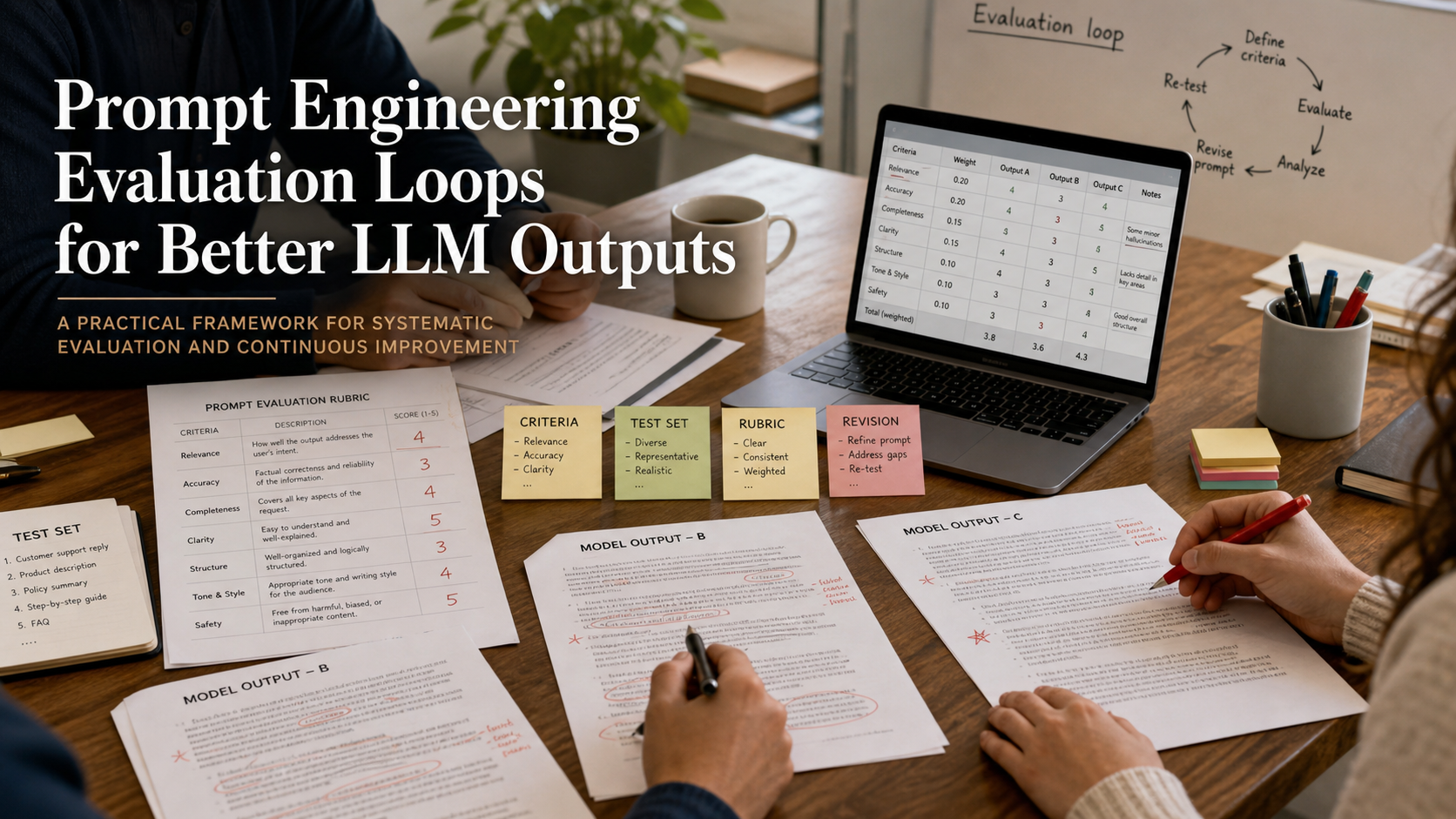
Editorial note, prepared May 9, 2026: Before publishing, add one original prompt test with a weak prompt, improved prompt, rubric, and model output comparison.
Prompt engineering does not become reliable because a prompt sounds clever. It becomes reliable when the team can test whether the output improved. That is why every serious prompt workflow needs an evaluation loop.
A good evaluation loop connects success criteria, examples, test inputs, scoring, revision, and production monitoring. It works for support replies, sales summaries, product research, code review, and content workflows. It can also work for video tools: if a team uses Recapo to turn long videos into scripts, voiceovers, subtitles, and recap clips, prompts should be evaluated against clarity, accuracy, pacing, and publishability.
Key takeaways
- Start with success criteria before rewriting prompts.
- Build a small test set with easy, typical, and difficult inputs.
- Use a rubric that scores the output against the job, not against vibes.
- Track prompt version, model, temperature or reasoning settings, and source input.
- Use Recapo-style video recap workflows as a practical example: the output must be accurate, concise, and ready for editing.
What is a prompt evaluation loop?
A prompt evaluation loop is a repeatable process for testing whether a prompt produces better outputs across realistic inputs. Instead of asking "did this one answer look good?" the team asks "does this prompt perform better across our actual work?"
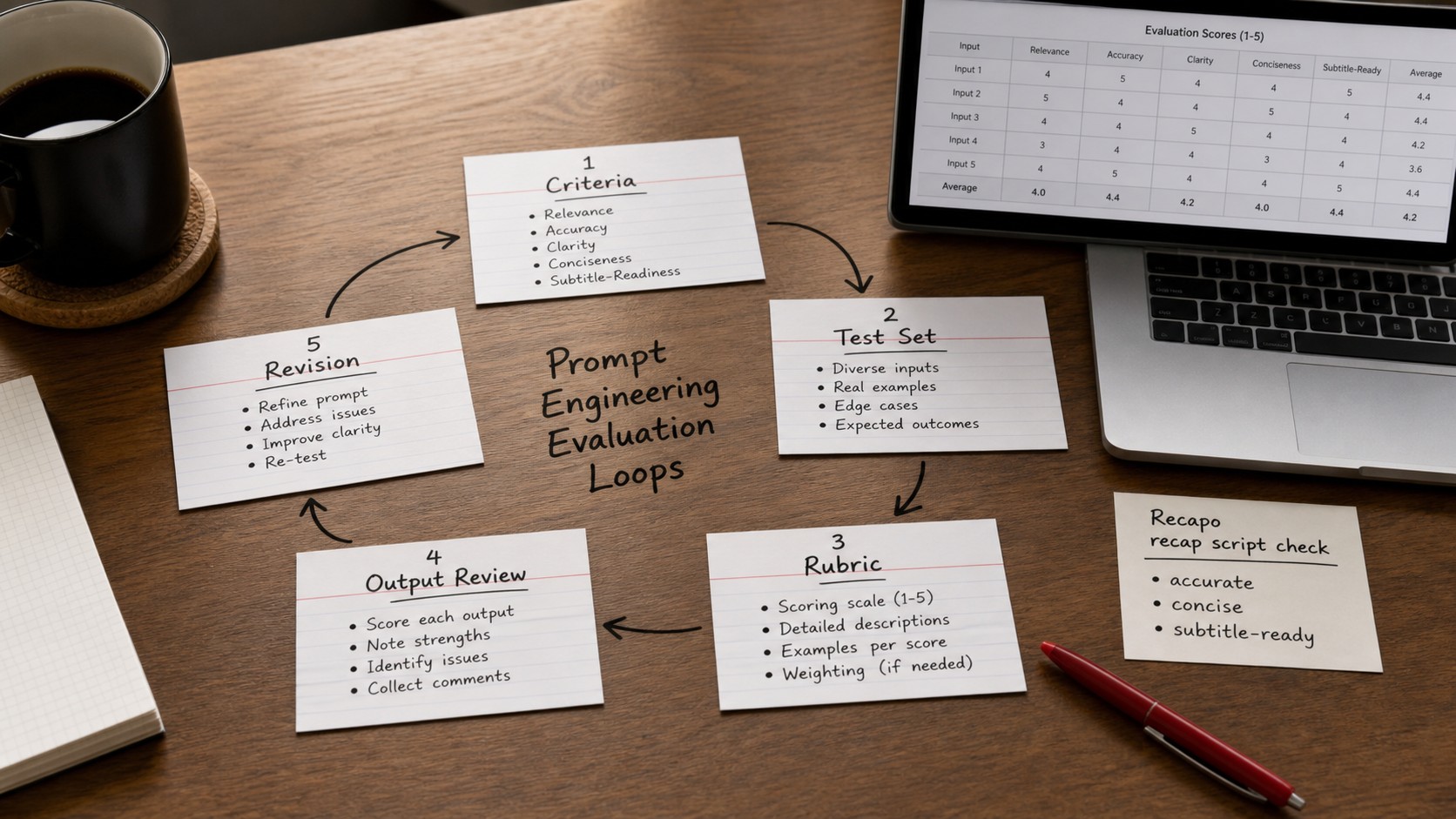
| Loop stage | Question it answers | Example |
|---|---|---|
| Success criteria | What does good mean? | The recap script preserves claims, removes filler, and fits 45 seconds. |
| Test set | What inputs represent reality? | A clean demo, a rambling webinar, and a noisy interview. |
| Rubric | How will we score it? | Accuracy, concision, tone, structure, and editability. |
| Prompt revision | What changed? | Added source-grounding and output sections. |
| Monitoring | Does it still work? | Review a sample after model or product changes. |
How do you define success criteria?
Success criteria should be observable. "Better writing" is weak. "Keeps every product claim source-backed, uses fewer than 120 words, and produces three headline options" is testable. The same rule applies to video workflows. "Make this clip engaging" is weak; "extract three recap angles with a hook, subtitle draft, and one risk note" is much stronger.
For a Recapo workflow, success might include: the recap does not invent facts, the hook matches the source video, the voiceover script fits the target duration, and the subtitles are easy to scan on mobile.
How large should the test set be?
Start small. Five to ten examples are enough to expose most prompt problems. Include clean inputs, messy inputs, edge cases, and one input that should trigger uncertainty or refusal. The goal is to make prompt failure visible before the workflow scales.
- Easy case: short, clean source material.
- Typical case: normal customer or creator input.
- Messy case: filler, repetition, missing context, or contradictory instructions.
- Risk case: claims about pricing, safety, medical, legal, or current facts.
- No-answer case: source does not contain enough information.
What should the rubric score?
The rubric should be simple enough for a human reviewer to use quickly. Use five criteria at most. For most content and operations prompts, the useful criteria are accuracy, completeness, format compliance, tone, and actionability.
For video recap prompts, add publishability. A technically correct recap can still fail if it is too slow, too long, or impossible to subtitle cleanly.
E-E-A-T review notes
Experience: Add one prompt evaluation example before publishing: weak prompt, revised prompt, rubric, and output comparison. If using Recapo as the scenario, test whether a recap script preserves claims, fits the target duration, and produces usable subtitles.
Expertise: The article should stay grounded in prompt evaluation methods: success criteria, test sets, rubrics, versioning, and monitoring. Keep examples specific enough that a product or content team can repeat the test.
Trust: Do not claim that prompt engineering universally improves every model or every task. The safer recommendation is to test prompts against real inputs and update them when model behavior changes.
- Cite OpenAI and Anthropic guidance for prompt versioning, success criteria, and empirical testing.
- Use Recapo as a concrete evaluation case for video recap outputs, not as a universal prompt tool.
- Add a short update note if major prompting guidance changes before publication.
Final recommendation
Prompt engineering is not a one-time writing exercise. It is a loop. Define the job, test the prompt, score the outputs, revise, and keep a record. When the workflow touches publishable content, such as Recapo-generated scripts and recap clips, the evaluation loop is what keeps speed from turning into sloppy output.
References
- OpenAI prompting guide - official prompting tools and prompt versioning context
- OpenAI Evals API reference - official evaluation API reference
- Anthropic prompt engineering overview - success criteria and empirical testing guidance
Where to go next
Use these internal links to move from planning into tool selection, editing, and publishing workflows.
- Recapo - turn long videos into scripts, voiceovers, subtitles, and recap clips
- Prompt engineering category - more prompting systems and examples
- AI Agent Prompt Engineering - extend prompt evaluation to agent workflows
- AI tools directory - compare tools for prompt and workflow testing