
Editorial note, draft prepared April 22, 2026: This draft is decision-support content, not procurement advice. Add current pricing screenshots or founder examples before publishing.
The fastest way to waste money on AI is to buy a tool for a workflow you do not understand yet. The second fastest way is to build internally before you know whether the workflow matters.
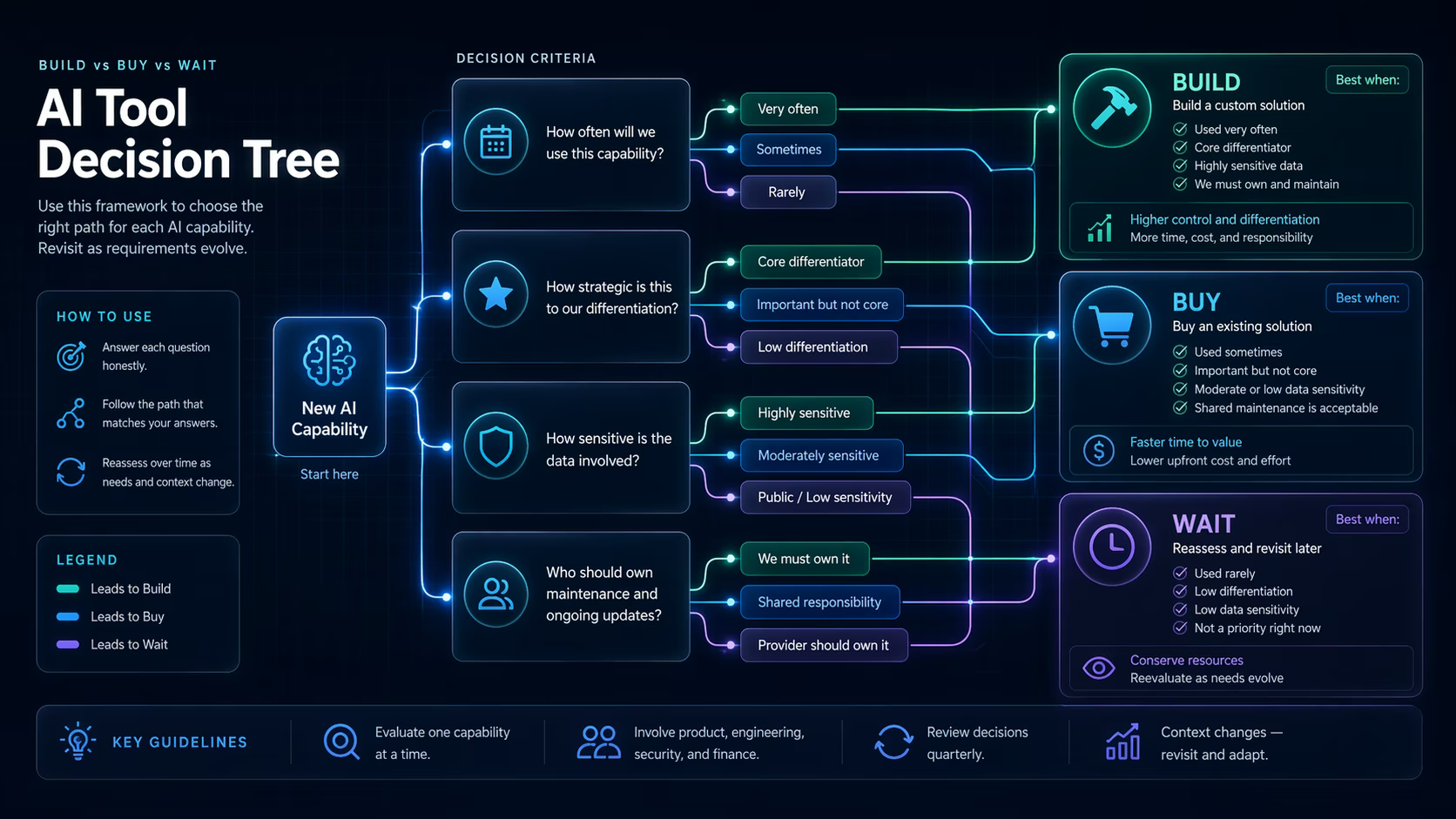
A good build vs buy AI tools decision starts with frequency, risk, data sensitivity, integration cost, and whether the workflow gives your company a lasting advantage.
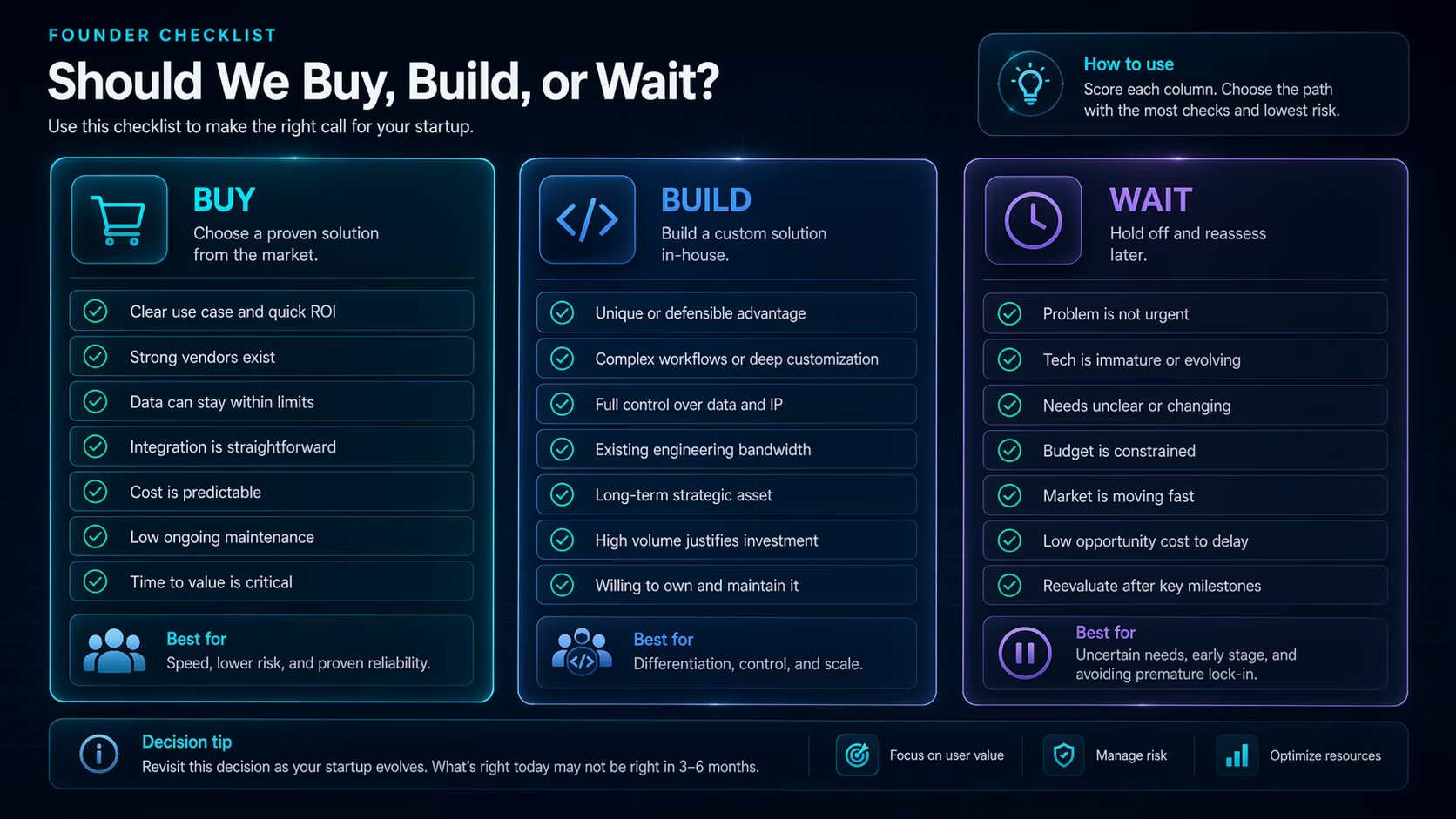
TL;DR: Buy when the workflow is common, low-risk, and already solved well by existing vendors. Build when the workflow is core to your advantage, depends on proprietary data, or needs deep integration. Stay manual when the process is still changing every week.
Who this guide is for
This guide is for startup founders and operators evaluating whether to buy another subscription from the AI tools list or build a narrower internal workflow.
- Founders comparing AI SaaS tools against internal automation.
- Operators trying to avoid tool sprawl.
- Teams that need a decision framework before reading industry insights and reviews.
The practical framework
The decision is not build or buy forever. It is build, buy, or wait for this stage of the company.
| Decision | Use when | Avoid when |
|---|---|---|
| Buy | The workflow is standard and vendors are mature | You need deep proprietary logic |
| Build | The workflow is strategic or data-sensitive | You cannot maintain it |
| Wait | The process is unstable | The pain is already expensive and frequent |
Start with frequency and pain
A monthly annoyance rarely deserves a custom AI workflow. A daily bottleneck that blocks sales, product, or support might. Frequency turns small inefficiencies into real operating cost.
Ask how often the task happens, who does it, how long it takes, and what goes wrong when it is late or inaccurate. The answer usually clarifies whether AI belongs here at all.
Buy when the workflow is not your moat
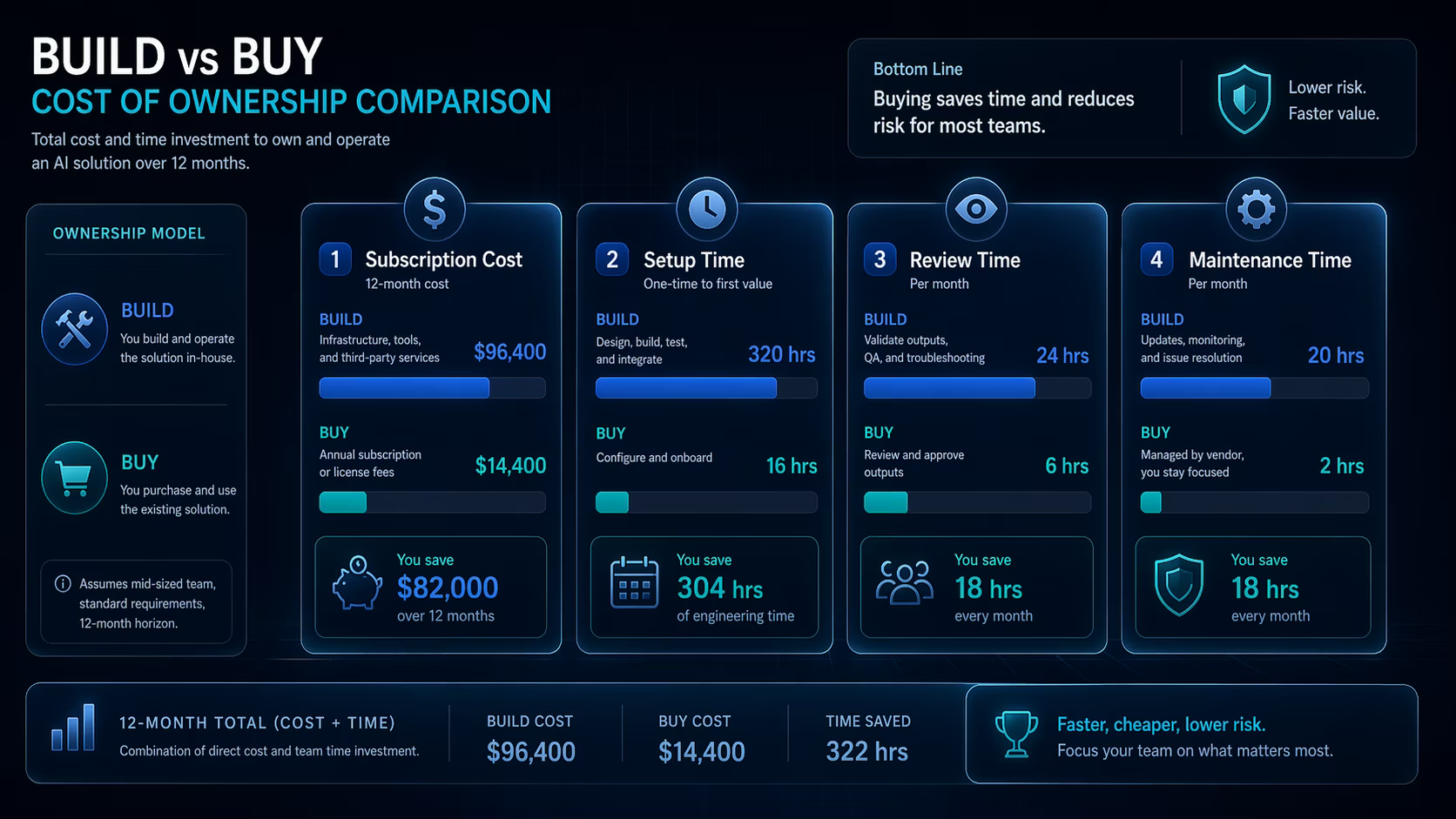
Most startups should buy for commodity workflows: meeting notes, basic image generation, simple writing support, transcription, scheduling, and common support drafts. Vendors are already competing on UX, integrations, and pricing.
Buying also helps you learn faster. A good vendor gives your team a working reference point before you spend engineering time building a narrower version.
- Buy when setup takes hours, not weeks.
- Buy when vendor failure does not break the business.
- Buy when the output can be reviewed quickly by a human.
Build when the workflow compounds
Building makes sense when the workflow improves with your proprietary data, internal taxonomy, customer history, or product-specific feedback loop. That is where generic tools stop short.
The hidden cost is maintenance. Someone must own prompts, evaluations, model changes, security reviews, and edge cases. If nobody owns it, the internal tool becomes shelfware.
| Build signal | Example | Risk to manage |
|---|---|---|
| Proprietary data | Customer-specific recommendations | Privacy and access control |
| Deep integration | AI inside the product workflow | Engineering maintenance |
| Unique judgment | Domain-specific review workflow | Evaluation quality |
Implementation checklist
- Estimate monthly hours spent on the task.
- List failure risks: privacy, accuracy, compliance, customer impact.
- Check whether existing tools already solve 80 percent of the job.
- Calculate maintenance ownership before building internally.
- Revisit the decision after 30 days of real use.
E-E-A-T notes for editors
Add a founder decision example before publishing: one workflow that should be bought, one that should be built, and one that should stay manual. This adds experience and reduces generic advice.
References and further reading
- Generator AI Tools reviews - review archive for evaluating vendor options
- Generator AI Tools leaderboard - ranking context for market visibility
Where to go next
Use these related pages to move from research into tool selection, comparison, and implementation.
- AI tools directory - compare existing vendors before building
- AI leaderboard - check which tools have market momentum
- Submit your AI tool - for founders who want to list their own product
Final recommendation
Founders should buy speed, build advantage, and wait on unstable workflows. The best decision is the one that reduces real operating pain without adding a maintenance burden the team cannot carry.