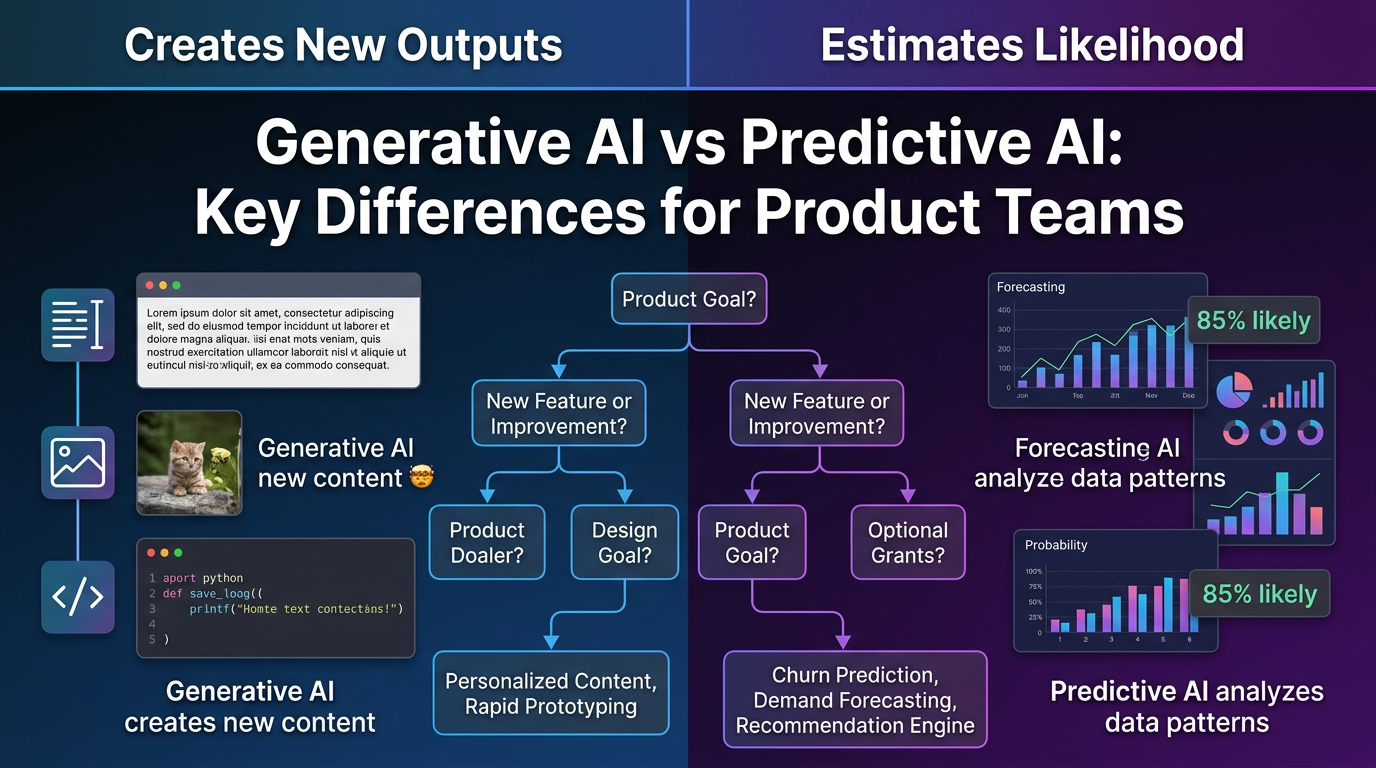
Generative AI and predictive AI solve different problems, even when people use them in the same product conversation. One creates new outputs. The other estimates what is likely to happen based on patterns in historical data.
Product teams make better decisions when they stop treating those two labels as synonyms. The model choice changes the user experience, the data requirements, and the way success should be measured.
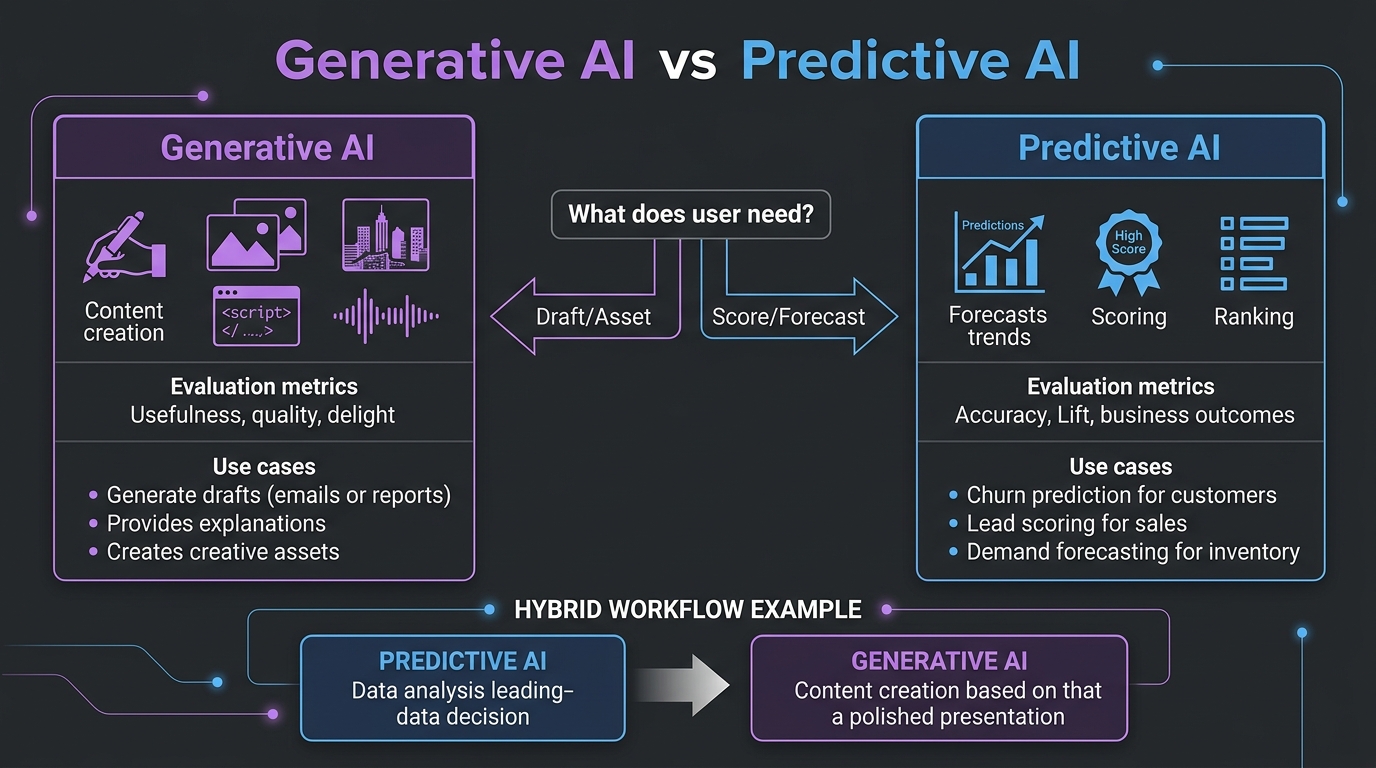
Short answer: Generative AI is best for creating content, interfaces, and conversational outputs. Predictive AI is best for scoring, forecasting, ranking, and estimating future outcomes from historical patterns.
Where generative AI fits
Generative systems are useful when the output itself is the product experience.
- Writing, summarization, ideation, and conversational assistance.
- Generating images, code, audio, or drafts from prompts.
- Helping users create faster inside the product.
Where predictive AI fits
Predictive systems are stronger when the question is about likelihood.
- Forecasting churn, lead quality, demand, fraud risk, or conversion probability.
- Ranking, scoring, and recommendation problems.
- Operational decisions that depend on historical pattern detection.
Why product teams should care
The wrong label leads to the wrong roadmap.
- Generative features are usually evaluated by usefulness, quality, and delight.
- Predictive features are usually evaluated by accuracy, lift, and business outcomes.
- Blending the two is powerful, but only if the team knows which layer is doing what.
How to decide which one you need
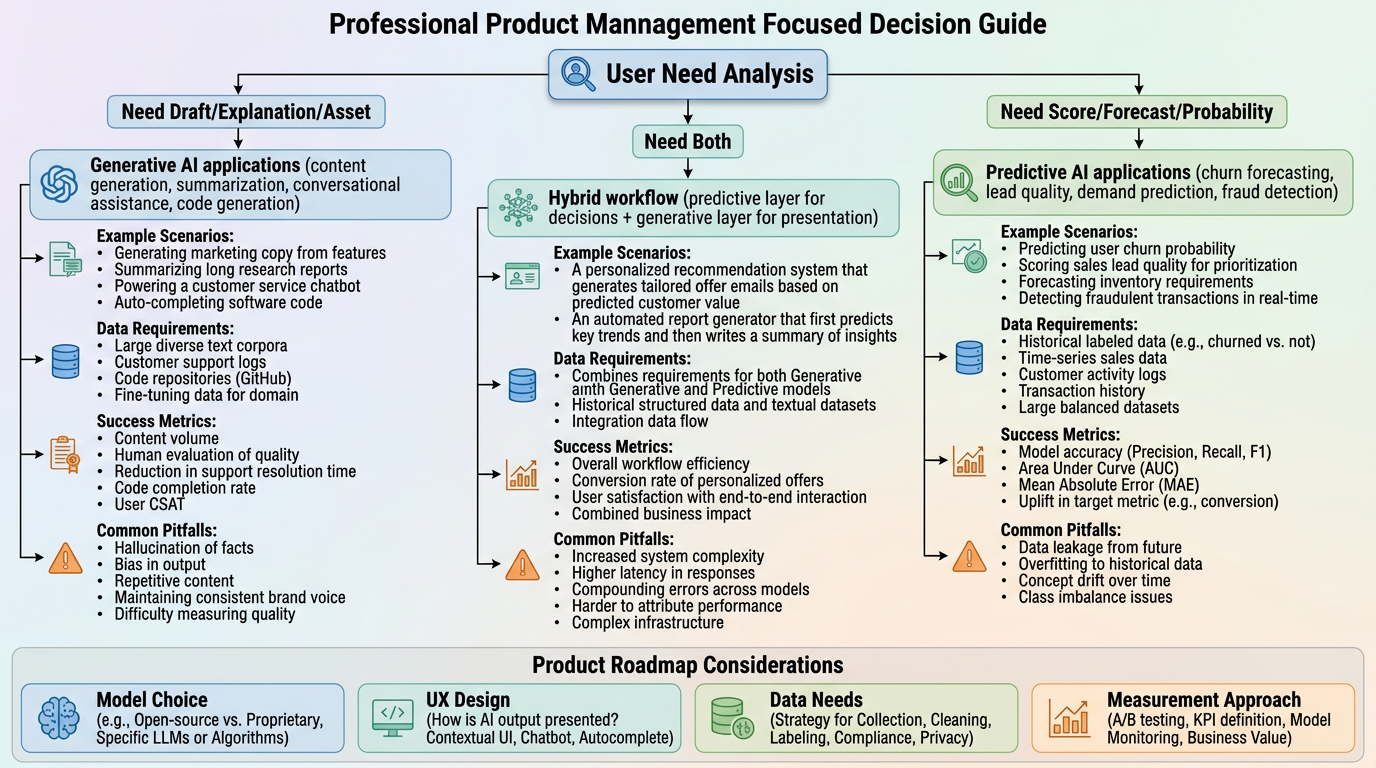
The fastest decision rule is to ask what the user needs back from the system.
- If the user needs a draft, explanation, or asset, generative AI is likely involved.
- If the user needs a score, forecast, or probability, predictive AI is likely involved.
- If the workflow needs both, build the predictive layer for decisioning and the generative layer for presentation.
How we approach AI industry coverage
This guide is attributed to Priya Patel, AI Industry Analyst at Generator AI Tools. For industry pieces, we focus on what changes practical decision-making: product launches, workflow shifts, market structure, pricing pressure, and the difference between headline noise and actual operational impact.
- We aim to translate market changes into plain-language consequences for builders, marketers, and operators.
- We avoid treating a single product demo as proof that a category has fundamentally changed.
- We encourage readers to validate current details against company announcements, product pages, and official documentation where applicable.
What to verify before acting on this article
- Check whether the products or policies mentioned have changed since publication.
- Confirm pricing, rollout scope, and availability directly with the companies involved.
- For regulated or risk-sensitive topics, verify the most recent official guidance before making decisions.
Bottom line
Generative AI and predictive AI are not competing labels. They are different tools for different jobs. Product teams usually win by combining them intentionally instead of confusing them conceptually.