
OpenAI Privacy Filter Brings Local PII Redaction Into the AI App Stack
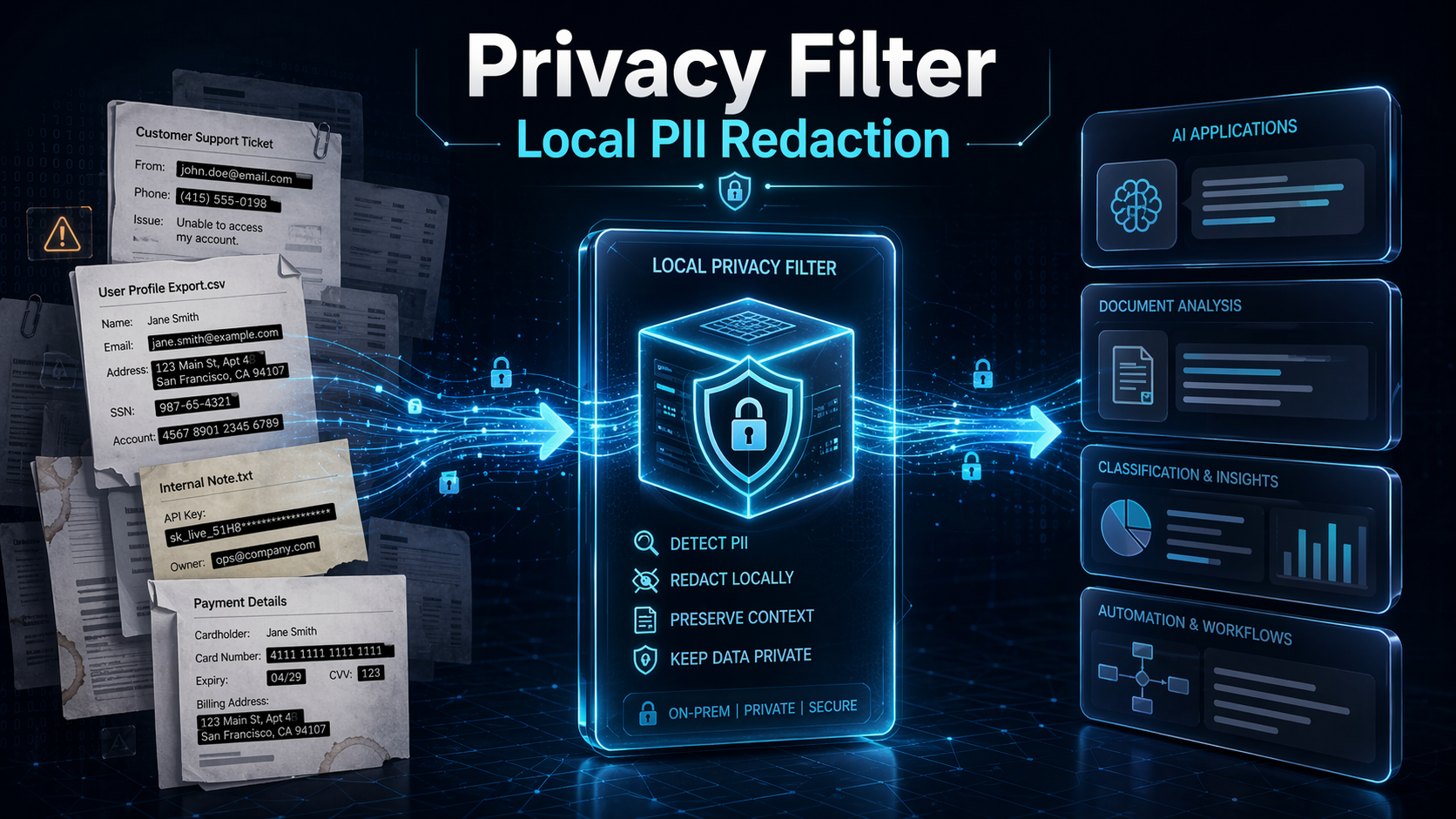
Updated April 23, 2026. OpenAI has released Privacy Filter, an open-weight model designed to detect and redact personally identifiable information in text before that data moves deeper into AI systems.
The practical news is not just that another model is available. It is that OpenAI is framing privacy filtering as infrastructure: something teams can run locally, tune for their own policies, and insert into training, indexing, logging, support, and review pipelines.
What OpenAI announced
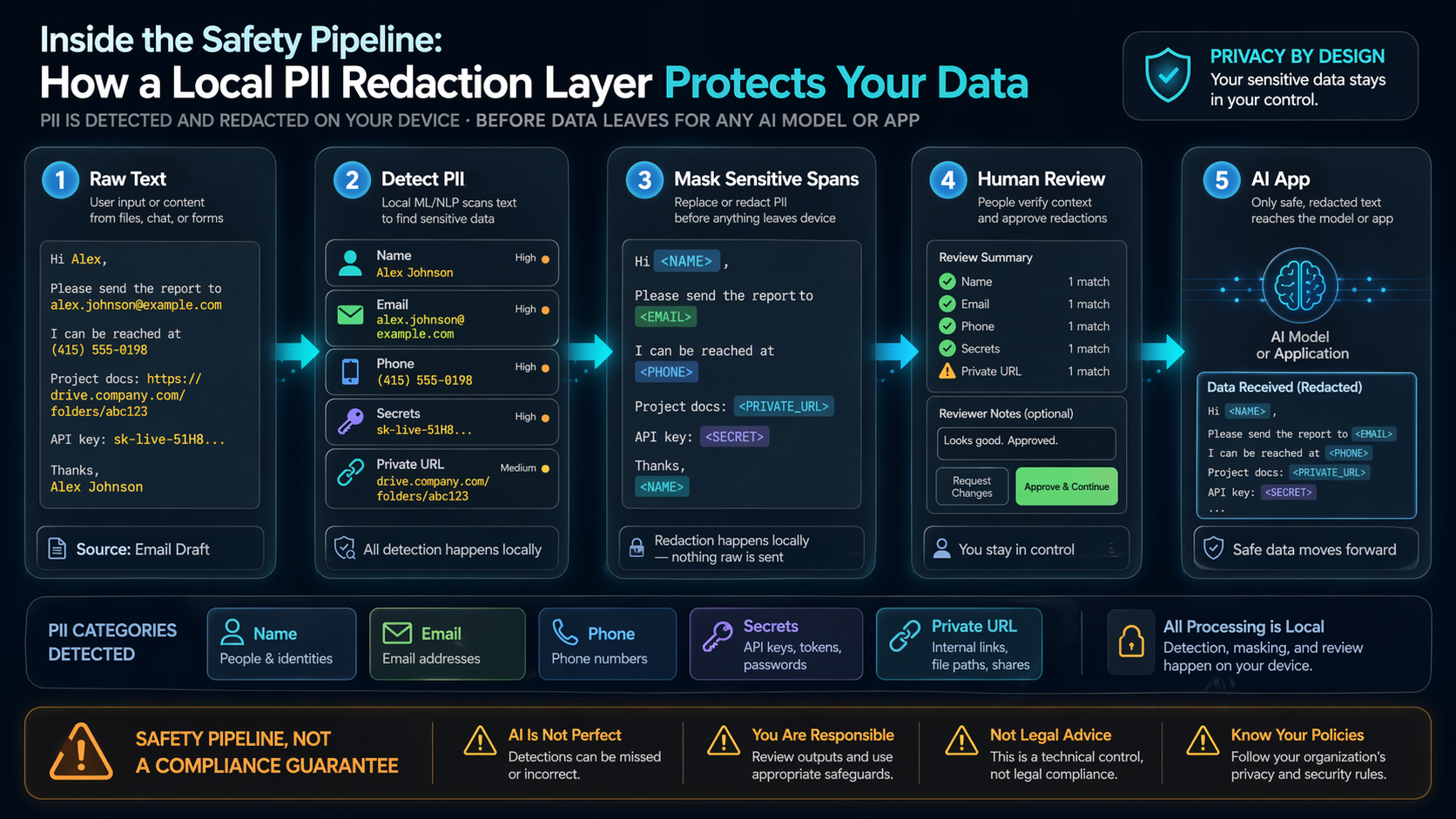
According to OpenAI, Privacy Filter is a 1.5B-parameter model with 50M active parameters. It uses token classification and span decoding to identify categories such as private names, addresses, emails, phone numbers, private URLs, dates, account numbers, and secrets like passwords or API keys.
The model supports long inputs and is designed for one-pass detection rather than generative rewriting. That makes it more useful for high-throughput privacy workflows where the system needs to preserve the useful parts of the text while masking sensitive spans.
The E-E-A-T angle
For teams evaluating privacy tooling, the trustworthy part of the announcement is the amount of implementation detail. OpenAI published architecture notes, label categories, benchmark claims, availability terms, and limitations instead of only presenting a product headline.
The release also includes an important caveat: Privacy Filter is not a compliance certificate or a complete anonymization system. For legal, medical, financial, and other sensitive domains, teams still need policy review, domain-specific evaluation, and human oversight.
What teams should test before relying on it
| Question | Why it matters |
|---|---|
| Does it catch private data in your own writing style? | Benchmarks rarely capture every company-specific naming convention, ticket pattern, or internal shorthand. |
| Does it over-redact useful business context? | Too much masking can make logs, support summaries, or research notes less useful. |
| Can it detect secrets in code and developer notes? | Security-sensitive strings often look different from consumer personal data. |
| Can your team audit failures? | Privacy filters should create reviewable evidence, not a black box. |
What to watch next
The most interesting signal is that a major AI lab is shipping a small, inspectable, local model for a narrow trust problem. If adoption is strong, expect more focused models for AI governance: data classification, prompt risk review, policy routing, source verification, and security triage.
For readers comparing AI tools, this release is a reminder to evaluate not only model quality but the surrounding safety stack. Start with the AI tools directory, then check whether each product explains privacy handling, redaction, retention, and human review.
Sources
Related Coverage
Related AI news
AI News
OpenAI Releases GPT-5.5 for ChatGPT and Codex
OpenAI is rolling out GPT-5.5 to paid ChatGPT users and Codex, positioning the model for agentic coding, research, data analysis, and multi-tool work.
AI News
OpenAI Expands Trusted Access for Cyber With GPT-5.4-Cyber
OpenAI is expanding its Trusted Access for Cyber program and introducing GPT-5.4-Cyber for vetted security teams, signaling a shift from blanket model restrictions to identity-based access controls.
AI News
OpenAI Rebuilds Agents SDK to Push AI Agents Toward Production
OpenAI has rolled out a major rewrite of its Agents SDK, turning what had largely been a lightweight chatbot-oriented toolkit into a more complete foundation for production-grade AI agents.