
OpenAI Rebuilds Agents SDK to Push AI Agents Toward Production
OpenAI has rolled out a major rewrite of its Agents SDK, turning what had largely been a lightweight chatbot-oriented toolkit into a more complete foundation for production-grade AI agents.
The update brings together several pieces developers had previously been forced to assemble on their own: a native harness for execution control, native sandbox support for code and file operations, Codex-style filesystem tooling, and official integrations with seven major sandbox providers. In practical terms, OpenAI is trying to close the gap between models that can use computers and the infrastructure required to run those agents safely and reliably.
When GPT-5.4 launched with native computer-use capabilities in early March, many developers praised the model’s new behavior but pointed to a missing layer underneath it. The model could act on a computer, but developers still had to build or borrow their own systems for execution environments, safety controls, file access, and state management. With this release, OpenAI is moving to provide that missing layer itself.
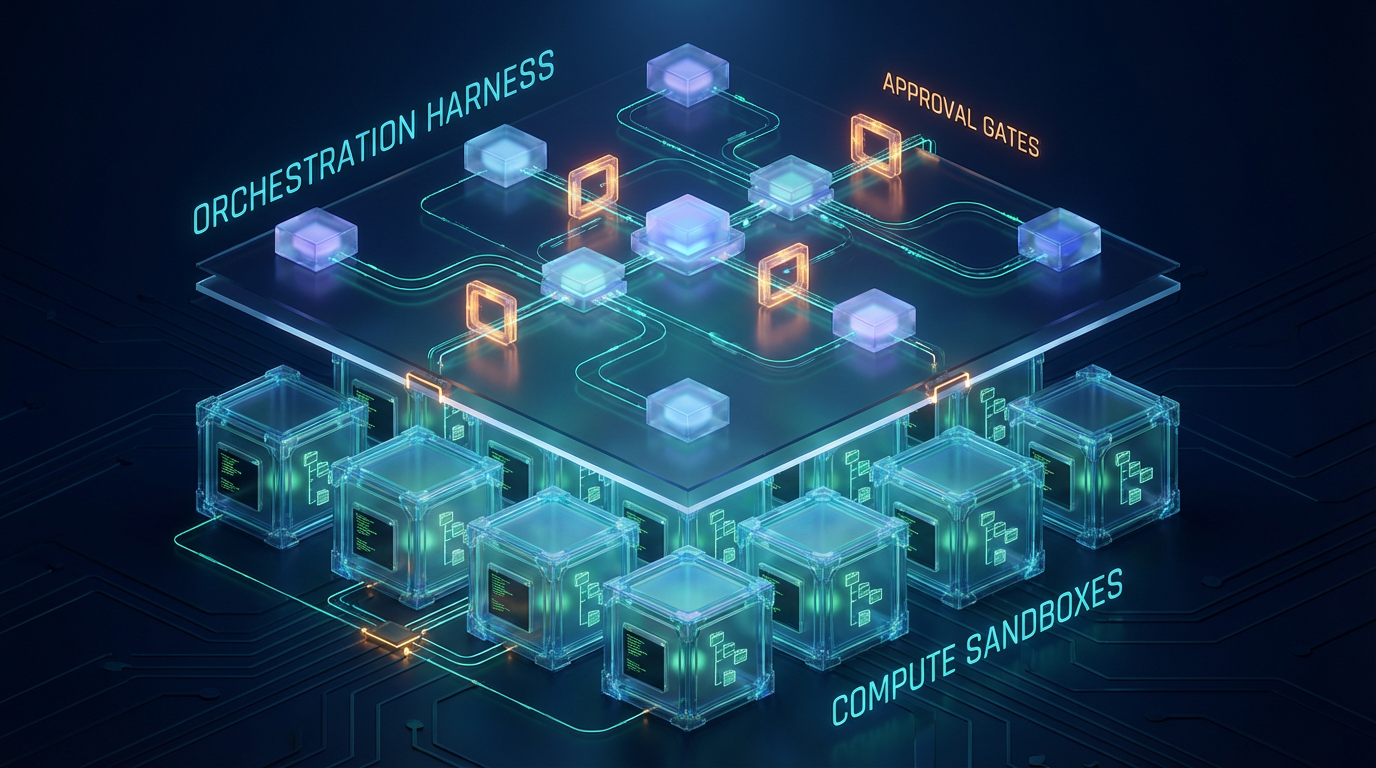
The core architectural shift is a clean separation between the harness and the compute layer.
The harness is responsible for orchestration: control flow, model calls, tool routing, approvals, tracing, and pause-and-resume behavior. The compute layer, by contrast, lives inside a separate sandbox and handles file reads and writes, dependency installation, command execution, and output generation. By decoupling the two, OpenAI says sensitive credentials can stay in trusted infrastructure while model-generated code runs in an isolated environment without direct access to API keys or other secrets.
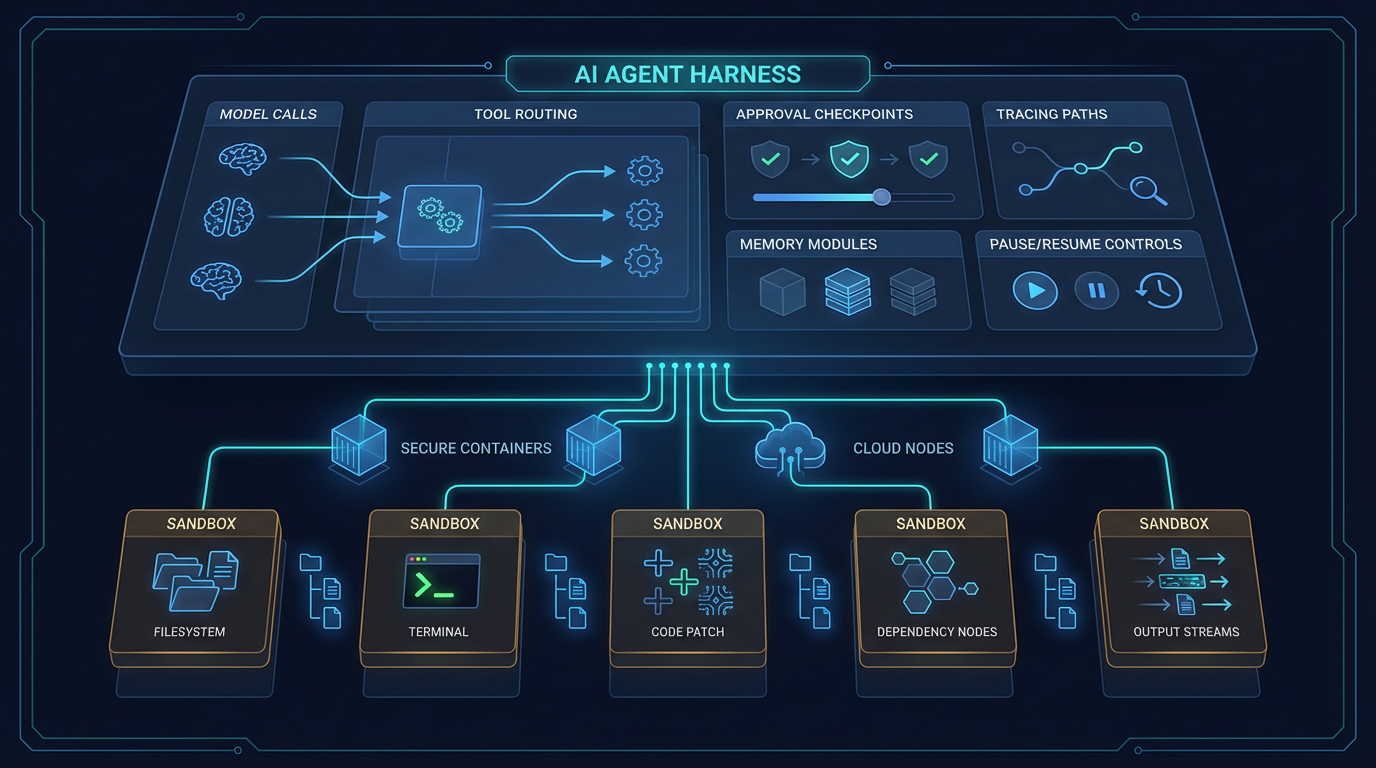
That makes the release more than a minor security upgrade. It signals a broader change in how agent systems are expected to be built. Instead of treating the model and its runtime as one loose bundle, OpenAI is formalizing a split between orchestration and execution. The company is also packaging in many of the patterns developers have come to associate with advanced coding agents, including configuration-based memory, filesystem tools similar to Codex, shell execution, patch-based editing, tool access through MCP, skill-based information disclosure, and custom instructions through AGENTS.md.
For developers familiar with Claude Code or Codex, that list will sound familiar. The difference now is that OpenAI is exposing those ideas directly in the SDK rather than leaving teams to reproduce them themselves.
Another major consequence of the rewrite is the rapid expansion of the sandbox ecosystem around the SDK. OpenAI now officially supports Blaxel, Cloudflare, Daytona, E2B, Modal, Runloop, and Vercel. The company says this is possible because of a new abstraction called Manifest, which defines an agent workspace in a provider-agnostic way.
Through the Manifest, developers can specify which local files to mount, where to fetch data from, and where outputs should be written. Support spans storage backends including Amazon S3, Google Cloud Storage, Azure Blob Storage, and Cloudflare R2. Because the Manifest is separated from the underlying sandbox vendor, developers can switch providers without rewriting core agent logic. An agent configured for one sandbox provider can, in theory, be moved to another with only a configuration change.
OpenAI also published a minimal example showing an agent running in a local sandbox, mounting a directory of financial data, and comparing FY2025 and FY2024 revenue, operating income, and operating cash flow. The example highlights one of the update’s main selling points: a task that once required a custom stack can now be implemented with relatively little code inside the official SDK.
The release also adds two features that matter especially for long-running agent workloads. One is snapshotting and state recovery, allowing work to resume if a sandbox container fails. The other is support for multiple sandboxes in parallel, along with isolated environments for sub-agents. Together, those features give agents native support for both persistence and parallelism—two capabilities that have been essential for turning demos into usable systems.
Industry partners used the launch to share early results. Modal engineer Erik Dunteman said Ramp has already been running a large internal coding-agent fleet on Modal, with more than half of the company’s pull requests created by agents. Stripe had earlier disclosed that its internal AI agents were generating more than 1,000 pull requests per week. The broader message behind those examples is that mature agent infrastructure is beginning to translate into measurable gains in software output.
Other companies described gains outside software engineering. FurtherAI CTO Sashank Gondala said the company used an agent to process more than 900 pages of insurance claim records with a reported 100% extraction success rate. In a sector where long, messy documents often break automation pipelines, that claim stands out. Tomoro AI engineer Douglas Adams said comparable agent functionality now requires roughly one-sixth as much code as before. Box developer relations lead Carter Rabasa described feeding business data to an agent, equipping it with Bash and Python tools, and successfully running an invoice reconciliation workflow inside a sandbox on an early attempt.
Those testimonials support OpenAI’s broader strategic move. Over the past year, frameworks such as LangChain, LangGraph, CrewAI, and AutoGen gained traction largely by filling the gap between powerful models and production-grade execution. Their value came from orchestration, memory, guardrails, tracing, and multi-agent coordination. OpenAI is now moving directly into much of that territory.
That does not mean third-party frameworks disappear. But it does narrow the space they occupy. If OpenAI becomes the default infrastructure layer for agents, outside frameworks may be pushed either upward into higher-level orchestration and vertical applications, or downward into specialized tooling and sandbox services. The middle layer—the part that made raw model APIs usable in production—looks increasingly contested.
The same logic applies to sandbox vendors. Official compatibility may bring adoption, but it also places those providers inside OpenAI’s ecosystem rather than beside it. A company that today appears as a partner could tomorrow be viewed mainly as a replaceable component in a larger OpenAI-controlled stack.
There are still clear limits. The new harness and sandbox capabilities are launching first in Python, while TypeScript support remains on the roadmap. The SDK also still carries a 0.Y.Z version number, a reminder that the product is not yet fully mature.
Even so, the direction is increasingly difficult to miss. GPT-5.4 introduced native computer use. The rewritten Agents SDK now supplies much of the runtime environment needed to make that capability operational in real business settings. For developers building agent products, the question is shifting from whether the pieces exist to whether they should standardize on OpenAI’s stack.
When GPT-5.4 first arrived, some critics dismissed it as an incremental release. This SDK overhaul suggests the bigger story may not have been the model alone, but the infrastructure OpenAI was preparing around it.
Related Coverage
Related AI news
AI News
OpenAI Privacy Filter Brings Local PII Redaction Into the AI App Stack
OpenAI released Privacy Filter, an open-weight model for detecting and masking personally identifiable information in text, giving teams a local option for safer AI data pipelines.
AI News
OpenAI Says Enterprise AI Is Moving From Point Tools to a Unified Agent Layer
OpenAI outlined an enterprise strategy built around Frontier, company-wide agents, and a unified AI superapp, arguing that businesses are moving beyond isolated copilots.
AI News
GPT Image 2 and the Same New AI Shift: When AI Images Start Looking Trustworthy
OpenAI's ChatGPT Images 2.0 release pushes AI image generation toward believable screenshots, readable text, UI mockups, and commercial visuals. The upside is faster creative work; the risk is synthetic...