Editorial note, draft prepared April 22, 2026: This draft is aimed at team adoption, not solo productivity. Add screenshots from real coding workflows and update tool-specific claims before publishing.
AI coding assistants are no longer a solo developer experiment. Engineering teams are asking harder questions: where should assistants be allowed, what should reviewers check, and how do we prevent speed from outrunning architecture?
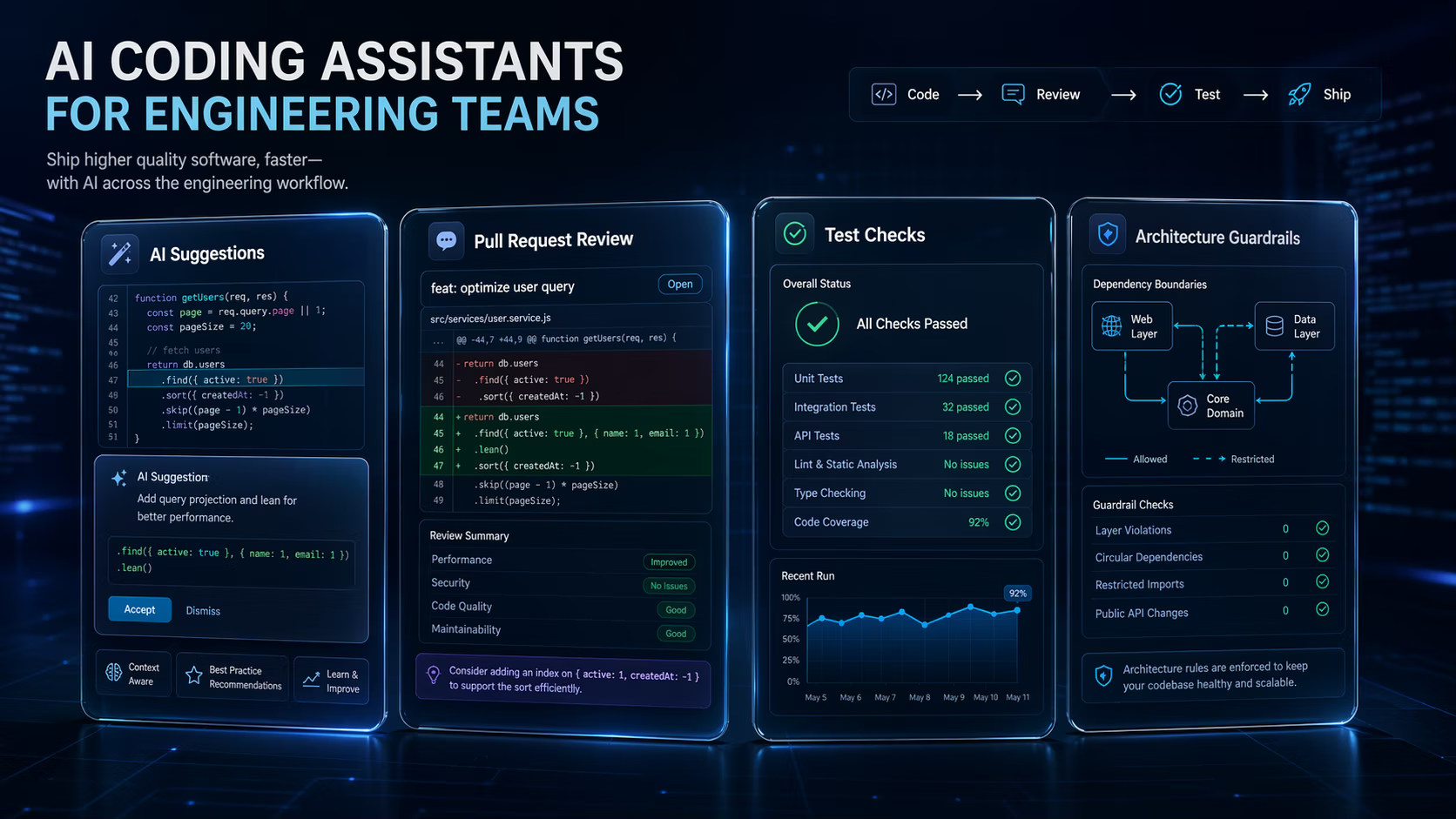
The best AI coding assistants for engineering teams improve flow without replacing engineering judgment. They help draft tests, explain code, generate scaffolds, and reduce repetitive work, but teams still need rules for review, security, and maintainability.
TL;DR: Adopt coding assistants by workflow, not by hype. Start with low-risk use cases, create review rules, protect sensitive code, track quality signals, and only expand after the team sees measurable improvement.
Who this guide is for
This guide is for engineering leads, staff engineers, and architects comparing developer tools for team use.
- Teams introducing Cursor, Claude Code, GitHub Copilot, or similar assistants.
- Architects designing review standards for AI-assisted code.
- Managers who need a rollout checklist before scaling usage.
The practical framework
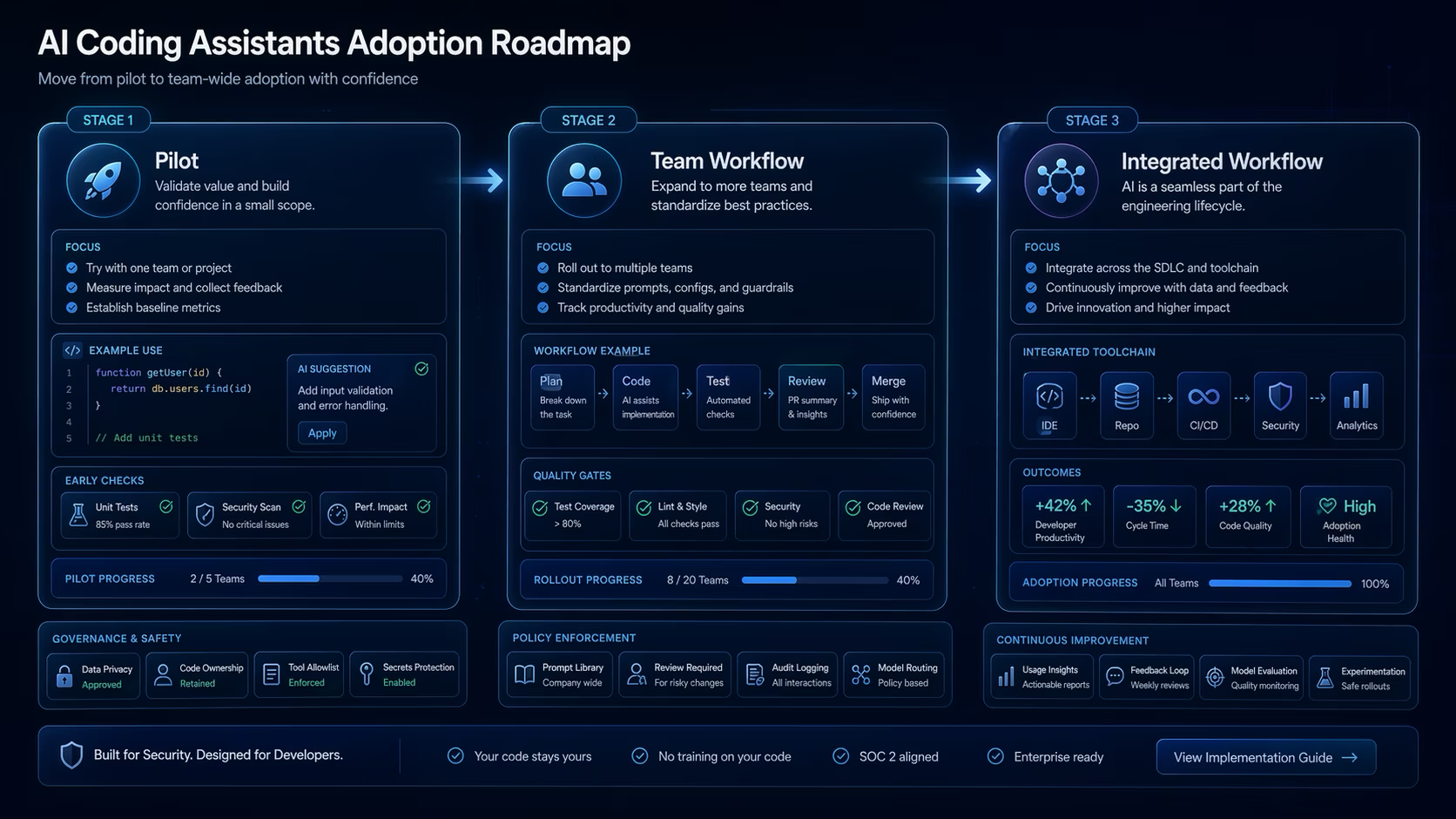
Team adoption should move through controlled stages, from safe use cases to broader implementation.
| Stage | Good use cases | Gate before expanding |
|---|---|---|
| Pilot | Tests, docs, code explanation | Reviewers see quality improvement |
| Team workflow | Scaffolding, refactors, migrations | Security and style rules are documented |
| Integrated workflow | PR summaries, issue triage, internal tooling | Metrics show less rework, not just faster output |
Start with low-risk coding jobs
The safest first use cases are work that already has clear acceptance criteria: unit tests, documentation, small refactors, code explanations, and boilerplate. These tasks are easy to review and less likely to introduce architectural drift.
Avoid starting with security-sensitive changes, billing logic, authentication, or large migrations. Those workflows need stronger evaluation and experienced review.
Create AI-assisted review rules
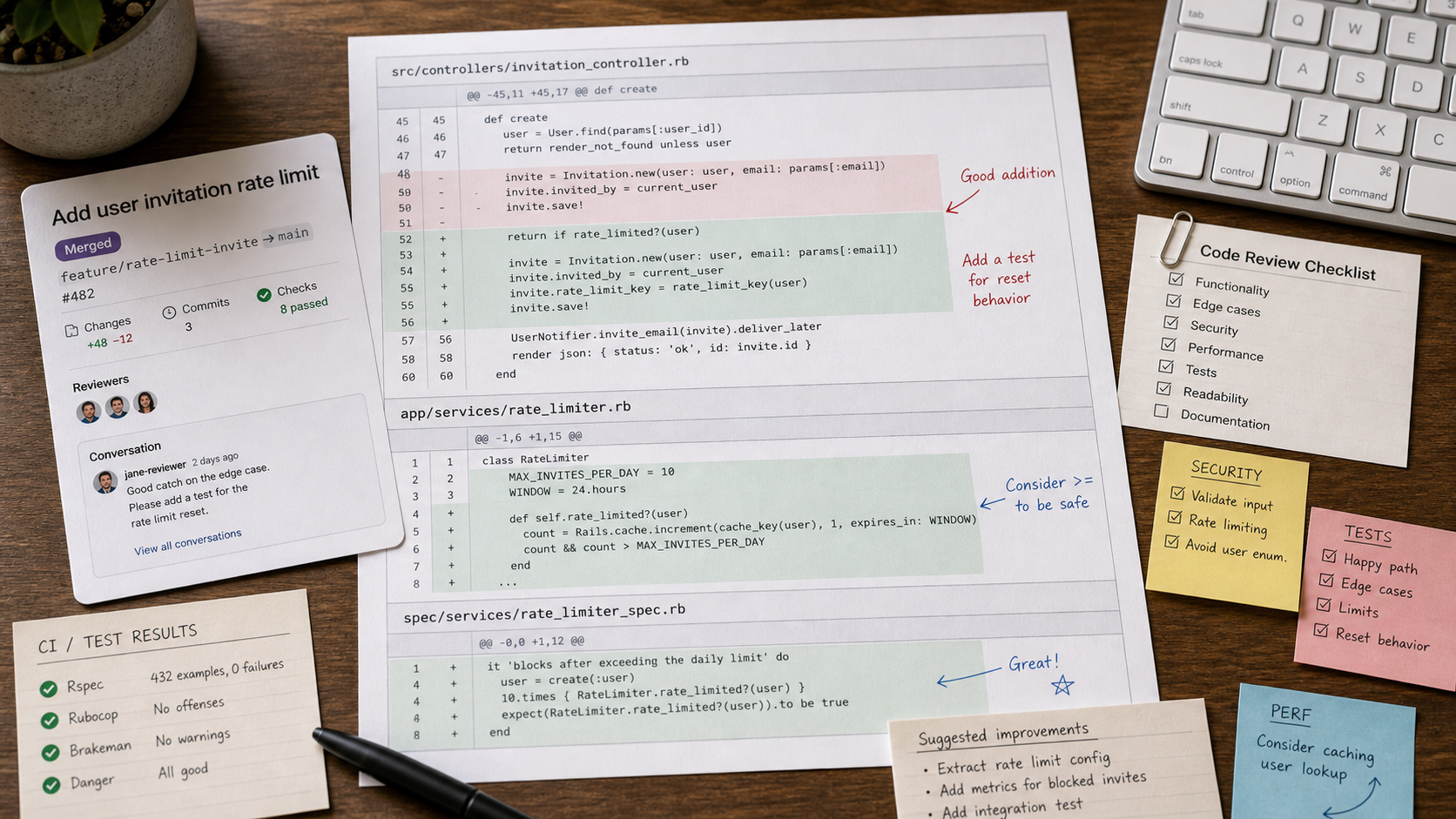
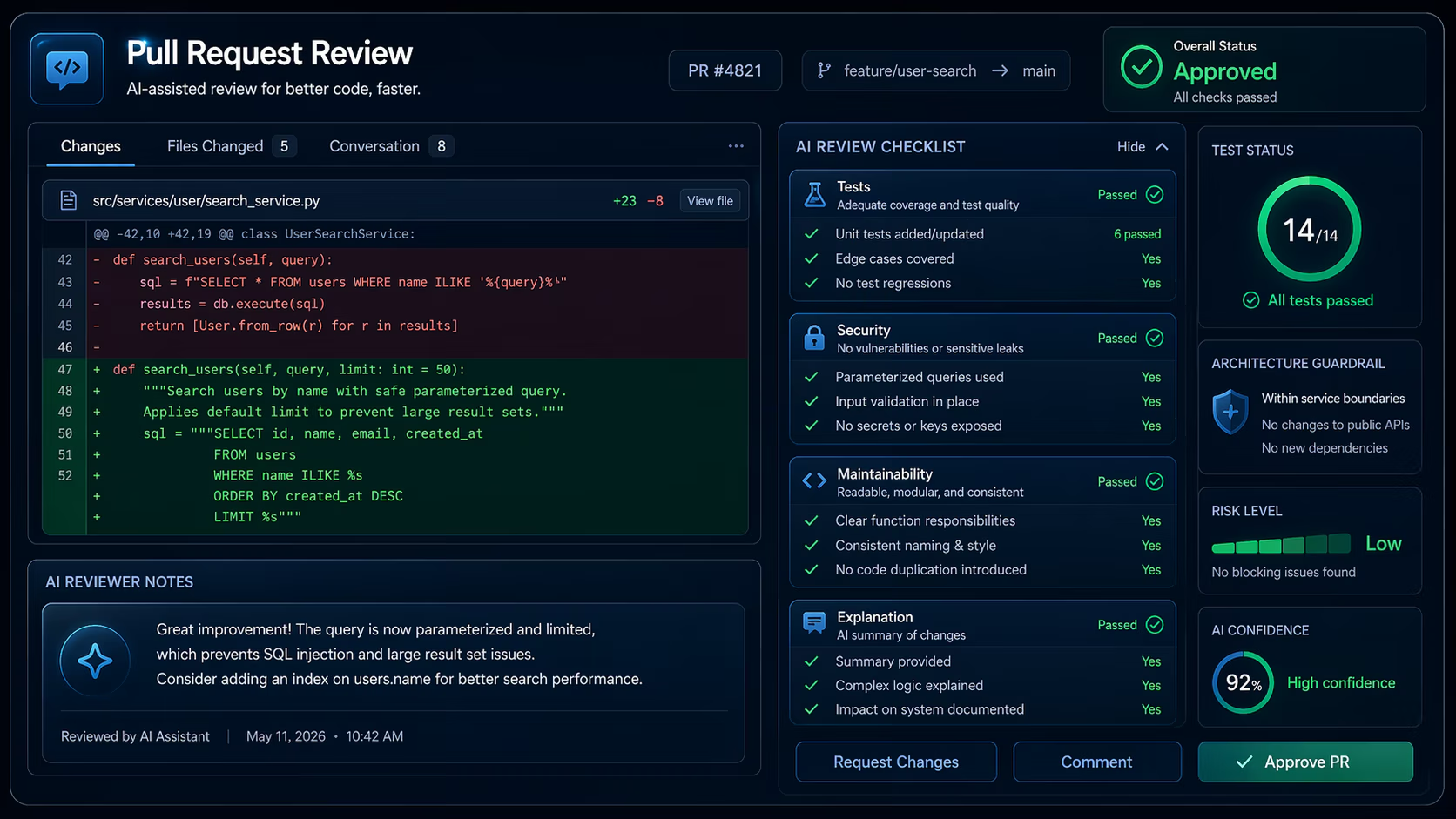
The review question should not be "did AI write this?" The better question is "does this change meet our engineering standards?" Teams still need reviewers to check correctness, performance, security, maintainability, and whether the implementation fits the architecture.
A simple rule helps: AI can accelerate drafts, but humans own merged code. That principle keeps accountability clear.
- Require tests for behavior changes.
- Ask authors to disclose uncertain AI-generated sections in the PR description.
- Reject code the author cannot explain.
- Use smaller PRs when assistants generate large diffs.
Track quality, not just speed
Coding assistants can make teams feel faster while quietly increasing review burden. Track cycle time, review comments, escaped defects, flaky tests, and rework. Speed is useful only if quality holds.
For teams comparing tools, pair metrics with hands-on feedback. A tool that works for one developer may not fit the whole team or codebase.
| Metric | What it reveals | Healthy signal |
|---|---|---|
| PR cycle time | Delivery speed | Faster without larger PRs |
| Review comments | Review burden | Fewer repeated issues |
| Escaped defects | Quality risk | No increase after rollout |
| Test coverage | Verification behavior | More meaningful tests |

Implementation checklist
- Pick three approved use cases for the first pilot.
- Document data and repository access rules.
- Create PR review expectations for AI-assisted code.
- Track quality metrics for at least one sprint.
- Expand only after reviewers report less friction, not more.
E-E-A-T notes for editors
Noah should add a sample team policy and one anonymized PR review example before publishing. That gives the article practical experience and makes the architecture perspective credible.
References and further reading
- Stack Overflow Developer Survey 2025 - developer adoption and sentiment around AI tools
- GitHub Copilot documentation - official Copilot feature and policy documentation
Where to go next
Use these related pages to move from research into tool selection, comparison, and implementation.
- Coding and dev category - more developer workflow guides
- Cursor tool page - compare AI coding editor workflows
- GitHub Copilot tool page - compare Copilot for team adoption
Final recommendation
The winning team is not the team that lets AI write the most code. It is the team that uses assistants where they reduce friction, keeps review standards high, and measures whether the workflow improves the software.